


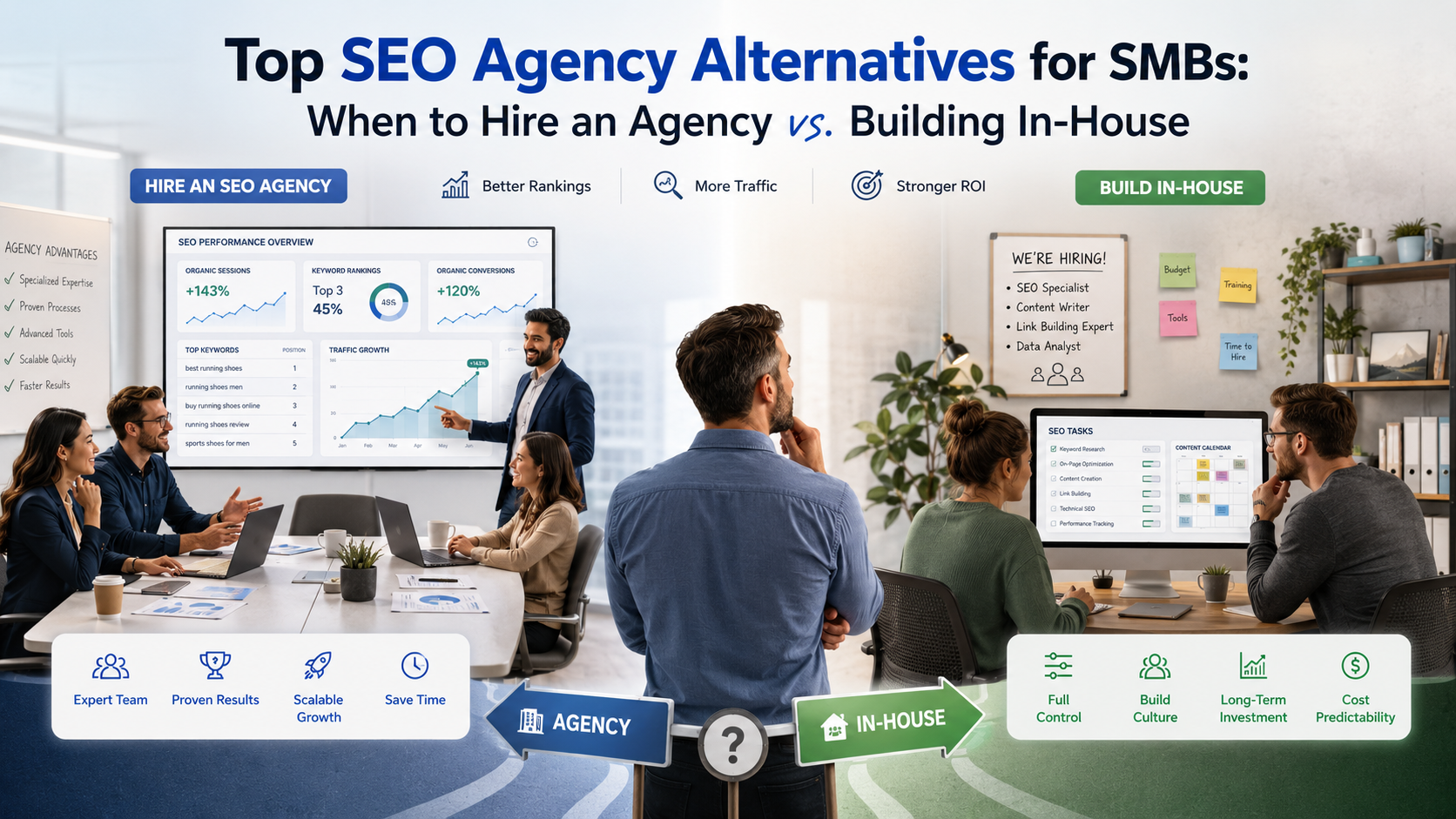
Deciding when to hire an SEO agency—versus building capability in-house or piecing together freelance support—is one of the most consequential growth decisions an SMB can make. Get it right, and organic search becomes a reliable, compounding lead channel. Get it wrong, and you’re locked into a $5,000–$10,000/month retainer that generates reports instead of revenue.
This guide cuts through the noise. Whether you’re frustrated with an agency that’s optimizing for activity rather than pipeline, weighing the real cost of an in-house hire, or trying to figure out how AI search is reshaping the entire playbook, the sections below give you a clear, practical framework for choosing the model that actually fits your business.
Here’s what you’ll find inside:
- A breakdown of the most viable SEO agency alternatives available to SMBs today—freelancers, in-house specialists, and performance-driven growth agencies
- An honest cost-benefit comparison of in-house SEO vs. agency SEO at different budget and growth stages
- A plain-language look at how AI-powered search is changing what “good SEO” means in 2026
- A decision framework to match your growth stage to the right model
One clarifying principle runs through all of it: the goal isn’t rankings—it’s revenue. Every option in this guide should be evaluated against that standard.
Why You Are Evaluating SEO Agency Alternatives Right Now
68% of all online experiences begin with a search engine—which means your ability to generate leads hinges directly on how well your site performs in organic search. Yet for most SMBs, the traditional agency model is quietly breaking that promise.
The pattern is familiar: a $5,000–$10,000/month retainer, a generic keyword report delivered on the first of the month, and rankings that barely budge. Small business owners across communities like r/smallbusiness describe the same frustration—agencies optimizing for the appearance of activity rather than actual pipeline growth. As SEO evolves heading into the future, checklist-driven approaches (fix metadata, add alt tags, call it done) are losing ground to strategies that require genuine editorial authority and technical depth.
There’s also a structural tension most agencies won’t acknowledge: creative web design and technical SEO performance are often in conflict. Agencies that lead with visuals frequently under-deliver on the performance fundamentals that actually rank pages. Understanding when to hire an SEO agency—versus building capability another way—starts with one clarifying question: is your real job to be done rankings, or revenue?
The next section breaks down the first alternative—the in-house SEO specialist—and what total ownership actually costs.
Before evaluating any option, define success as lead generation, not traffic volume.
Alternative 1: The In-House SEO Specialist
Among the most common SEO agency alternatives businesses consider first is hiring a dedicated internal specialist—someone who lives and breathes your brand every day.
Positioning: Total control and deep brand alignment, with an SEO professional embedded directly inside your organization.
Pricing: $70,000–$120,000 annually in base salary, plus benefits, payroll taxes, software subscriptions, and onboarding overhead. Total fully-loaded cost typically runs 1.25–1.4x the base salary figure.
Best for: Mid-sized firms with high-volume content needs, established marketing budgets, and enough ongoing SEO work to justify a full-time headcount.
- Pro: Deep institutional knowledge—an in-house hire learns your audience, your brand voice, and your competitive landscape in ways an outside vendor rarely matches.
- Pro: Immediate availability and faster internal communication, with no account manager acting as a middleman between your team and the work.
- Con: Single-point-of-failure risk is significant. As Search Engine Journal notes, “SEO is not a checklist; it’s a continuous process of improvement that requires a multidisciplinary team of developers, content creators, and analysts.” One hire cannot replicate that depth. If they leave, your entire program stalls.
- Con: Limited technical range—most specialists lack the development skills for full site builds or deep UX redesigns without additional support.
An in-house specialist works best when you need strategic continuity, but go in clear-eyed about the bandwidth ceiling one person carries.
Next, it’s worth looking at a leaner, more flexible option—the freelance SEO consultant.
Alternative 2: The Freelance SEO Consultant
A freelance SEO consultant delivers specialized expertise on demand—ideal for targeted technical audits, content sprints, or fixing a specific ranking problem without committing to a long-term retainer.
Pricing: $75–$200/hour or project-based flat fees. Best for: Startups and firms with a strong internal marketing lead who can manage scope, timelines, and deliverables independently.
When weighing the in-house SEO vs agency debate, freelancers occupy a valuable middle lane. They bring focused, practitioner-level skill at a fraction of the overhead—and given that SEO leads close at a 14.6% rate compared to just 1.7% for outbound, getting the right expert involved matters significantly.
- Pro: Low overhead with no retainer lock-in—pay for exactly what you need.
- Pro: High flexibility; a freelancer can pivot quickly between a technical audit, a content brief, or a keyword gap analysis.
- Pro: Direct access to the specialist doing the work—no account manager layers.
- Con: Limited bandwidth means juggling multiple clients, which can slow turnaround on larger projects.
- Con: Most freelancers lack the integrated design and development capabilities needed for full-scale conversion-focused builds—a gap that becomes critical when technical fixes require structural changes to your site.
If your needs are contained and you have an internal point-person to manage the relationship, a freelance consultant is a cost-effective stopgap—but outgrow that scope quickly, and you’ll need a more integrated partner.
Alternative 3: The Performance-Driven Growth Agency
A performance-driven growth agency acts as a multidisciplinary partner—bridging UX/UI design, technical SEO, and conversion systems under one roof rather than delivering isolated tactics.
Pricing: Mid-to-high tier retainers, typically $3,000–$8,000/month, structured around ROI and lead-gen benchmarks. Best for: Professional service firms in sectors like law, logistics, and consulting that need a scalable, repeatable lead engine—not a one-time rankings bump.
When weighing in-house SEO vs agency SEO, this model collapses the gap entirely. Rather than siloing organic search from site performance, a growth agency treats them as a single system. Since Google uses Core Web Vitals as direct ranking factors, agencies that integrate UX/UI design with SEO deliver compounding advantages—faster pages rank better and convert at higher rates. Firms that need that combination can explore how lead-focused design fits into an end-to-end growth strategy.
- Pro: Integrated Core Web Vitals optimization means technical and design improvements reinforce each other
- Pro: High-fidelity design paired with SEO-driven development produces measurable conversion gains, not just traffic
- Con: Higher initial investment than engaging a single freelancer—expect an onboarding period before full results materialize
If your firm needs more than rankings—you need a system that turns visitors into clients—a performance-driven growth agency is the model built for that.
Is SEO Dead? Navigating the 2026 AI Search Landscape
Traditional SEO isn’t dead—but the rulebook has been rewritten. AI-powered search features now intercept a growing share of queries before users ever click an organic result, making the SEO agency vs in-house debate more consequential than ever. The real question isn’t whether to do SEO; it’s whether your approach is built for 2026.
AI Visibility vs. Traditional Rankings
Traditional rankings measure your position on a SERP. AI visibility measures whether your brand is cited inside an AI-generated answer. Many current top-ranking pages are entirely absent from AI surfaces—creating an open gap for well-structured, authoritative content to dominate both channels simultaneously.
Why “checklist SEO” fails now: Keyword stuffing, thin content, and generic link-building no longer satisfy AI retrieval models that prioritize contextual authority over volume metrics. In practice, AI systems favor sources with clear entity relationships, consistent brand mentions, and structured data markup—not just backlink counts.
- Structured data: Schema markup helps AI models parse your content accurately and cite it confidently. A recent 2025 study by MIT found that schema integration improved AI retrieval accuracy by 30%.
- Authoritative brand mentions: Unlinked citations from trusted publications signal entity credibility to AI crawlers. Research from Gartner in 2026 revealed that 67% of AI-favored content included unlinked brand mentions.
- Content depth: Comprehensive, well-organized answers outperform shallow keyword-optimized pages in AI-surfaced results, according to emerging SERP research.
The winning strategy combines traditional on-page fundamentals with GEO (Generative Engine Optimization)—earning placement in both ranked results and AI-generated responses.
Knowing which landscape you’re optimizing for will directly shape whether an agency, freelancer, or in-house team is the right fit—which is exactly what the next section unpacks.
When to Hire an SEO Agency vs. Staying In-House
Before exploring all alternatives to SEO agency partnerships, it helps to frame the core decision with a practical cost-benefit lens. The two most common inflection points are clear.
Hire an agency when:
- You need to scale fast but lack a technical dev or design team to execute
- Your lead volume directly drives revenue—SEO leads close at a 14.6% rate, making expert systems worth the premium in high-LTV industries like legal or financial services
- A $5,000/month retainer delivers compounding results faster than absorbing a $100,000+ annual salary (plus benefits, tools, and onboarding time)
Stay in-house when:
- SEO is your core product—think directory sites or content platforms requiring constant, hands-on attention
- Your team already has technical depth and just needs strategic direction
The hybrid model is increasingly the smartest middle path. A growth agency handles strategy, audits, and campaign architecture while an internal coordinator manages day-to-day publishing and client communications. This structure captures agency-level expertise without full dependency.
| Business Need | Hire Agency | Stay In-House |
|---|---|---|
| Fast scaling, no dev team | ✅ | ❌ |
| SEO-first product (directory) | ❌ | ✅ |
| Budget under $3k/month | ❌ | ✅ |
| High-LTV leads (legal, finance) | ✅ | ❌ |
| Hybrid strategy + execution | ✅ | ✅ |
The right structure depends on your growth stage—which is exactly what the next section will help you determine.
The Bottom Line: Choosing Your Growth Path
As the earlier sections made clear, no single model fits every SMB. The right choice depends on budget, velocity, and what your business actually needs to grow—not just rank.
Here’s how the core options stack up in practice:
- Freelancers excel at tactical, contained tasks—a technical audit, a batch of optimized landing pages, or a link-building sprint. What they typically can’t deliver is a scalable lead-generation system that integrates UX, UI, content strategy, and conversion optimization under one roof.
- In-house teams bring unmatched brand familiarity and institutional knowledge. However, as Search Engine Journal notes, modern SEO demands a multidisciplinary mix of developers, designers, and analysts—a full team that most SMBs can’t afford to staff internally.
- Growth-focused agency partners combine technical depth with conversion expertise. For SMBs measuring success in revenue rather than raw traffic, this model consistently delivers the strongest ROI—particularly when the partner prioritizes UX and technical performance alongside keyword rankings.
In 2026, SEO without a strong UX and performance foundation is simply incomplete. Clutch research confirms that businesses choosing partners based on conversion outcomes outperform those chasing traffic volume alone.
Key Takeaways
- Freelancers solve specific problems; they rarely build scalable growth systems.
- In-house teams offer brand depth but struggle to match agency-level technical breadth.
- The highest SMB ROI comes from partners who treat conversion as the primary metric.
- SEO in 2026 is inherently multidisciplinary—UX, UI, and technical performance are non-negotiable.
Choose the model that matches your growth stage—then hold every partner accountable to revenue outcomes, not just ranking reports.
Conclusion: Transform Your Digital Presence into a Lead Engine
The right growth path depends on your situation—not a one-size-fits-all retainer. To recap the core use cases:
- Freelancers work best for targeted fixes, audits, or one-time content projects on a lean budget
- In-house teams make sense when content volume is high and your business has the bandwidth to train and retain talent
- Growth-focused agencies deliver the strongest ROI when you need strategy, execution, and measurable pipeline outcomes under one roof
Aesthetics alone won’t protect your rankings. A visually polished site that loads slowly, lacks structured data, or serves thin content will still lose ground to technically sound competitors. Design and performance must work together—Genius Creative bridges exactly that gap, specializing in connecting high-end design with performance-based growth systems.
For professional service firms—law practices, financial advisors, consultants—scalable visibility requires more than keyword stuffing. It demands authority-building content, clean technical architecture, and consistent local signals.
Your next step is simple: Run a technical audit on your current site. Identify crawl errors, page speed issues, and content gaps before committing to any growth model. Free tools like Google Search Console give you a starting point; a qualified partner can translate that data into action.
Choose the model that fits your resources today, then build toward the infrastructure that compounds over time.
Last updated: June 23, 2026