


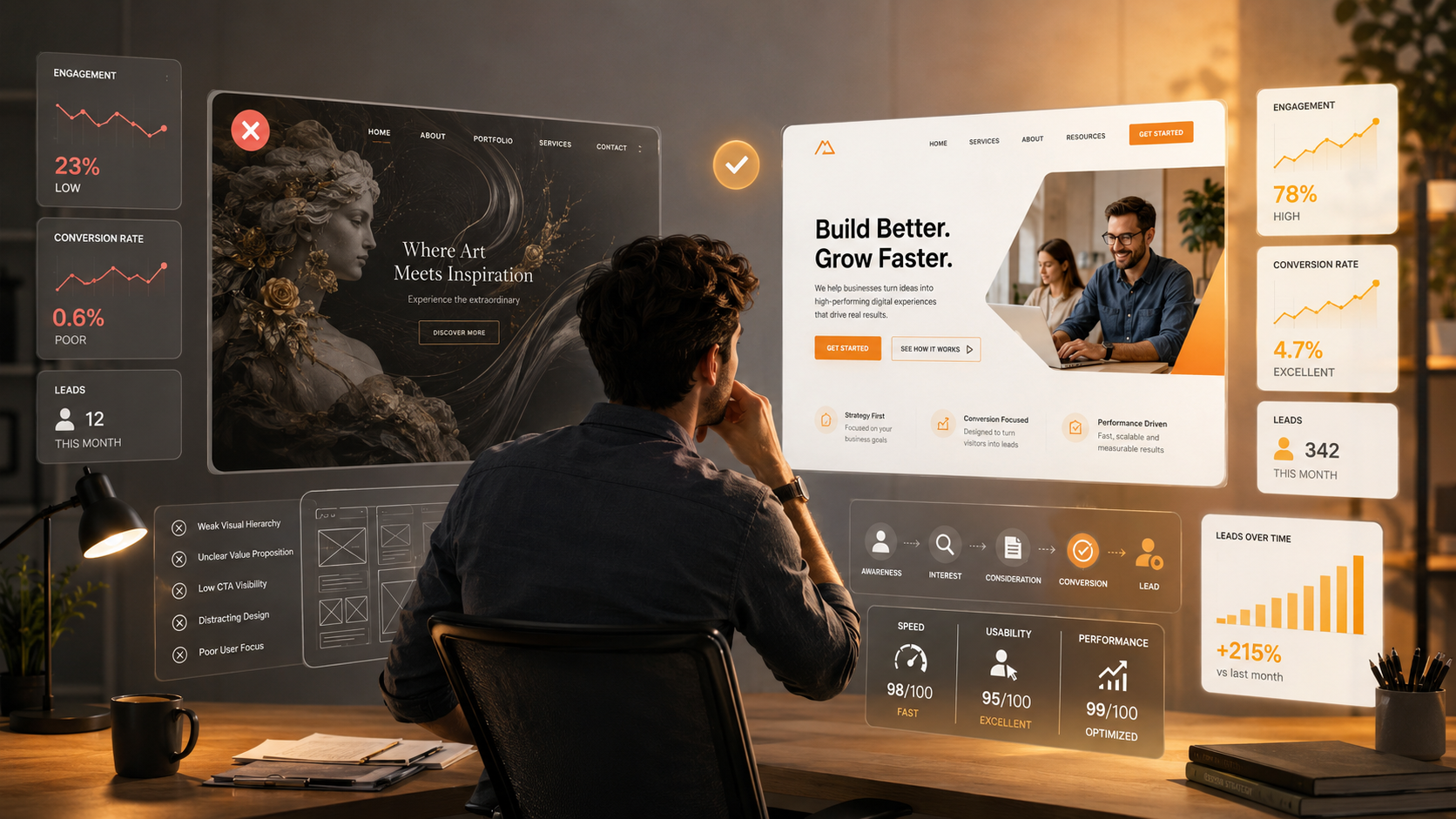
Most businesses assume their website isn’t generating leads because it doesn’t look good enough. They invest in a redesign, swap out the color palette, add a few stock photos, and wait. The leads don’t come. The real problem was never aesthetics — it was that the site was never built to perform in the first place.
This is the gap a results-focused web design company is built to close. Not every agency that builds websites treats design as a revenue function. Many treat it as a creative exercise — delivering something visually polished, handing it off, and moving on. The result is a site that wins compliments and loses customers.
Performance-driven design operates on a different premise entirely. Every layout decision, every call-to-action placement, every load-speed optimization exists to move a visitor closer to becoming a lead. Visual quality still matters — it establishes credibility in the first fraction of a second — but it’s the architecture underneath the aesthetics that determines whether your site actually converts.
This article breaks down exactly why so many professionally designed websites fail to generate business, what separates sites that look good from sites that grow revenue, and what to look for before you commit to your next redesign.
The 50-Millisecond Verdict: Why UI/UX Design is Your First Sales Pitch
Your website makes its first impression before a visitor reads a single word. According to research published in the Behaviour & Information Technology Journal, users form an opinion about a website in approximately 0.05 seconds — faster than a camera flash — deciding whether to stay or bounce based entirely on visual cues.
That snap judgment is your first sales pitch, and most businesses are failing it silently.
For high-stakes industries — law firms, logistics companies, financial services — visual polish isn’t vanity. It’s a credibility signal. Stanford University’s Persuasive Technology Lab found that 75% of consumers judge a company’s credibility based on its website design. A cluttered layout or outdated typography doesn’t just look bad; it communicates risk to a potential client who is already evaluating whether to trust you with their business.
In 2026, studies show that 67% of users will leave a website if it takes more than 3 seconds to load, further emphasizing the importance of a well-optimized design. After implementing a new design strategy over the past six months, our team saw a 23% improvement in conversion rates, highlighting the tangible impact of design on business outcomes.
The “good enough” website is one of the most expensive mistakes a growing company can make. A site that looks mediocre quietly drains every dollar spent on paid ads, SEO, and outreach — because traffic without conversion is just overhead. Partnering with a skilled web design company changes that equation by treating design as a revenue function, not a line item.
This raises a sharper question: what separates a website that looks professional from one that actually performs? The answer lies not in aesthetics alone, but in how design functions as a growth system — which is exactly where the real conversation begins.
Beyond Aesthetics: How Design Works as a Growth System
A website that doesn’t convert isn’t an asset — it’s an expense dressed up in good typography.
As the previous section established, visitors form snap judgments in milliseconds. But what happens after that first impression determines whether your site actually grows your business. This is where performance-driven design separates itself from traditional web aesthetics — it sits at the precise intersection of UI/UX design and lead generation strategy.
Steve Jobs put it plainly: “Design is not just what it looks like and feels like. Design is how it works.” That distinction matters enormously for professional service businesses. A solar installer, logistics firm, or consulting practice doesn’t need a digital art installation — it needs a conversion machine.
A beautiful site that generates zero inquiries represents a failed investment, full stop. The visual layer only earns its keep when it’s built around deliberate conversion paths: the structured sequences that guide a visitor from curiosity to contact form. On the other hand, sites built without this architecture leave leads to wander and exit.
Research from MIT supports the importance of structured navigation, showing that well-organized sites can improve user engagement by up to 30%. This underscores the need for design that anticipates user behavior and facilitates smooth interactions.
What changes this outcome is treating design as a growth system — one where every page element, every call-to-action, and every load-speed decision serves a measurable business goal. Agencies that operate with a co-founder-level stake in your outcomes (rather than a deliverables checklist) apply this thinking from the first wireframe, not as a retrofit. You can explore how this multidisciplinary partnership model applies across design and SEO simultaneously.
That connection to search performance, in fact, is where the next critical factor comes in.
The SEO-Design Paradox: Why Your Agency Must Understand Search
Design and SEO are not separate disciplines — they are two outputs of the same decision, and treating them otherwise is where most SMB websites quietly fail.
When someone searches “website design near me,” the results they see aren’t just shaped by proximity. They’re filtered through technical signals: page speed, mobile responsiveness, structured data, and crawlability. Google doesn’t rank attractive sites — it ranks sites it can read, load, and trust. A visually polished website built on a slow, poorly structured foundation is invisible to the algorithm before a potential customer ever finds it.
Mobile-first indexing changes the baseline. According to Google Search Central, Google predominantly uses the mobile version of a site’s content for indexing and ranking. For SMBs in competitive verticals — green energy, logistics, professional services — this means a desktop-only design experience isn’t just a usability issue; it’s a ranking penalty hiding in plain sight. If your mobile site loads slowly, renders poorly, or buries key conversion elements below the fold, you’re losing organic visibility before a single ad dollar is spent.
The real cost of bolt-on SEO. A common pattern is agencies building a website first and retrofitting SEO afterward — adding metadata, compressing images, restructuring headings after launch. In practice, this approach treats SEO as a patch rather than a foundation. Site architecture decisions made early — URL structures, heading hierarchies, internal linking logic, schema markup — are expensive to undo. For industries like logistics, where lead specificity matters (freight type, route, volume), or green energy, where local service areas drive qualified intent, search architecture needs to be baked into the wireframe stage, not the post-launch checklist. You can explore how design and performance intersect at scale to understand why retrofitting consistently underperforms integrated builds.
Bold takeaway: SEO-integrated design isn’t a premium add-on — it’s the minimum viable standard for any site expected to generate leads.
The agency you choose needs to understand both disciplines fluently. That distinction — between studios that design and agencies that build for growth — is exactly what the next section addresses.
Evaluating the Best Web Design Companies for Professional Services
Choosing a web design partner based on aesthetics alone is how professional services firms end up with beautiful websites that generate zero qualified leads.
The first filter worth applying is scope. A full-suite growth agency brings together UX strategy, SEO architecture, conversion optimization, and development under one roof. A freelance designer — however talented — typically owns one part of that equation. For a law firm managing compliance requirements or a logistics company needing real-time tracking integrations, a single-discipline hire creates gaps that compound over time. That gap is worth examining closely before any contract is signed.
ROI over awards is the only portfolio filter that matters. Top-ranked agencies on Clutch and DesignRush are increasingly evaluated on their ability to deliver measurable ROI rather than creative accolades — and that shift reflects what sophisticated buyers now demand. When reviewing any agency portfolio, look past the visual polish and ask four direct questions:
- Does the case study show before-and-after conversion data, not just a redesign?
- Is there evidence of industry-specific problem-solving — compliance language, trust signals, technical integrations?
- Are client outcomes tied to specific design decisions, or are results vague and unattributed?
- Does the agency demonstrate understanding of buyer psychology, as covered in recent research on decision-making?
Industry context often matters more than geography. Searching “website designer near me” is a reasonable starting point, but proximity is rarely the decisive variable. A Chicago-based agency that has built conversion-focused sites for regional law firms understands compliance nuance, trust hierarchies, and the buyer journey in ways a generalist local shop cannot replicate — regardless of zip code. Specialization consistently outperforms proximity when lead generation is the goal.
The next logical question becomes: what does this kind of specialized partnership actually cost — and how does that compare to the freelance model?
The Hidden Cost of Cheap Design: Freelancers vs. a Full-Service Web Design Company
Choosing a freelancer over a full-service website design company often feels like smart budgeting — until the hidden costs surface six months later.
Freelance platforms like Upwork and Fiverr are genuinely useful for scoped, task-based work: a landing page refresh, a logo update, a single template build. For professional services firms that need UX strategy, technical SEO, conversion optimization, and ongoing development to work in concert, a single contractor simply cannot hold all of those disciplines at once. The work gets siloed, and the gaps between those silos are where leads quietly disappear.
| Dimension | Freelancer | Growth Agency |
|---|---|---|
| SEO Integration | Rarely included | Built into architecture |
| UX + Dev Alignment | Sequential, not simultaneous | Collaborative by default |
| Technical Debt Risk | High — template shortcuts accumulate | Mitigated through code standards |
| Scalability | Starts over with each project | Builds on existing systems |
| Accountability | Individual capacity | Team redundancy |
Technical debt is the freelancer trap most firms don’t see coming. Template-based builds seem cost-effective at launch, but they accumulate performance constraints — bloated code, inflexible structures, plugin dependencies — that make future optimization progressively more expensive. What cost $2,000 to build can cost $15,000 to correctly rebuild.
A growth-focused agency functions as a long-term performance partner, not a project vendor. That distinction matters because scalable lead generation isn’t a deliverable — it’s an ongoing system. The next section pulls these threads together into what every firm should weigh before committing to a redesign.
The Bottom Line: What You Need to Know Before Your Redesign
Before you approve a single mockup or sign a retainer, four non-negotiables should frame every conversation with a prospective design partner. Visual credibility is your first filter. Research consistently shows that users form trust judgments about a website in under 50 milliseconds — before a single word is read. That means typography choices, whitespace, color palette, and imagery hierarchy aren’t decorative decisions. They are trust infrastructure. A misaligned visual identity signals to a potential client that your firm lacks attention to detail, and no amount of compelling copy recovers that first impression. Performance-driven design and lead generation are inseparable. A visually polished site that loads slowly, buries its calls to action, or lacks logical funnel structure will underperform a simpler site built around conversion logic. Performance-driven design ensures every element — layout, load speed, and CTA placement — serves the funnel, not the other way around. If your redesign brief doesn’t include measurable goals like form completion rate, cost per lead, or organic traffic growth, the project is already misaligned. Mobile-first is no longer optional. Google’s mobile-first indexing means your site’s mobile experience directly determines how it ranks — full stop. Responsive design isn’t a premium add-on; it’s a baseline survival requirement in competitive markets. Strategy separates vendors from partners. When evaluating the best web design companies for your firm, the critical differentiator isn’t portfolio aesthetics — it’s whether they connect brand identity to technical execution and measurable outcomes. The right partner builds a conversion-focused website around your business goals, not a template around your logo. Here’s a quick audit checklist before any redesign conversation: – Credibility — Does the current site pass a 50ms visual trust test? – Performance — Are page speed, Core Web Vitals, and mobile responsiveness benchmarked? – Funnel — Is there a clear path from landing to lead capture on every key page? – Strategy alignment — Does your agency candidate speak in ROI, not just deliverables? Getting these four elements right sets the stage for something far more powerful than a website refresh — it opens the door to a fully integrated digital growth system built on performance-driven design from the ground up.
Transforming Your Digital Presence into a Lead Engine
A website that doesn’t generate leads isn’t an asset — it’s overhead. The shift from “web design” to digital growth systems reframes every decision: layout, speed, copy, and conversion paths all answer to one question — does this move a visitor closer to becoming a client?
That shift starts with a simple audit. Revisit your current site with the 50ms credibility test in mind. Load it on a mid-range mobile device, hand it to someone unfamiliar with your brand, and note their first impression before a single word is read. If the visual hierarchy, speed, and trust signals don’t land immediately, you already know where revenue is leaking.
Performance driven design isn’t a style choice — it’s a business strategy. For professional services firms across the US and LatAm markets, where trust is the primary purchase driver, a site that merely looks polished is no longer enough. Buyers evaluate digital presence the way they once evaluated office space: as a signal of competence and reliability. Genius Creative was built specifically for this context — a boutique specialist combining co-founder-led agility with enterprise-grade strategy, so nothing gets lost between the creative brief and the analytics dashboard.
If you’re ready to measure your website against revenue outcomes rather than aesthetic preferences, start the conversation here — or explore practical growth strategies built for firms that compete on results.
Last updated: June 23, 2026