


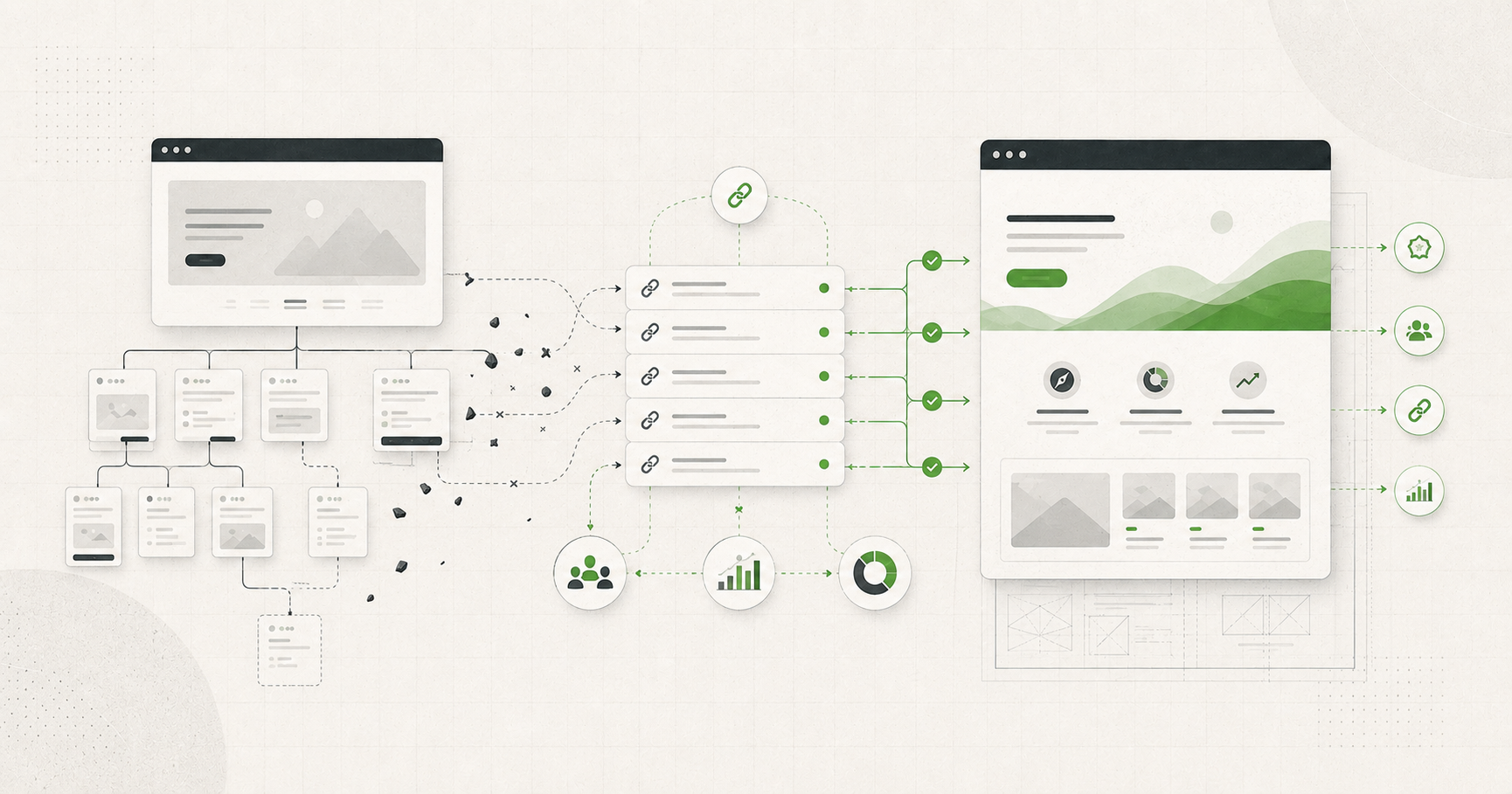
A redesign can make your website look newer while making your business significantly harder to find.
Companies usually begin redesign projects because the site feels dated, difficult to manage, or inconsistent with the current brand. Those are legitimate reasons. The problem appears when the project is treated as a visual replacement instead of a controlled change to an acquisition system.
Your existing website contains more than layouts and copy. It contains indexed URLs, search intent, internal links, external links, metadata, conversion paths, analytics history, and pages that may already generate qualified demand. Replacing that structure without documenting it can erase signals that took years to build.
This does not mean you should preserve a weak website indefinitely. It means every redesign needs an explicit plan for deciding what stays, what improves, what moves, and what disappears. That plan begins before the new interface is approved.
A redesign changes the acquisition system, not just the interface
The most expensive redesign errors often look harmless inside a design file. A navigation label becomes shorter, several service pages become one page, the blog moves to a different directory, or a developer generates a new URL structure. Each decision can change how users and search engines understand the business.
Consider what may be affected:
- Search intent. A page ranking for a specific commercial query may lose relevance when its detailed content is reduced to a short card on a general services page.
- Link equity. External websites may point to URLs that no longer exist. Without an appropriate destination, that referral value and user path are interrupted.
- Internal relationships. Breadcrumbs, contextual links, category pages, and navigation reveal how topics and services connect.
- Conversion context. A high-performing landing page may depend on a particular promise, proof element, form, or call to action that the new design removes.
- Measurement continuity. Changes to forms, domains, consent tools, analytics tags, or thank-you experiences can break comparisons and conversion tracking.
Designers do not need to preserve every paragraph or URL. They do need evidence before deciding that an element has no value. A visually repetitive section may answer an important objection. An old-looking page may generate the strongest organic opportunities. A small resource may have valuable backlinks.
Define success across several dimensions: usability, brand clarity, accessibility, search visibility, qualified leads, maintainability, and performance. If the brief only says modernize the website, the team has no shared standard for evaluating tradeoffs.
Once the redesign is understood as an acquisition change, you can build an inventory that protects what already works.
Build a prelaunch inventory before approving the new structure
You cannot protect assets you have not identified. Before finalizing the sitemap, collect a dependable view of the current website from analytics, search data, crawling tools, backlink data, and the content management system.
Your inventory should include:
- Existing URLs. Record indexable pages, redirects, canonical destinations, media, downloadable resources, and intentionally excluded URLs.
- Organic performance. Identify pages earning impressions, clicks, relevant rankings, and conversions over a representative period.
- Commercial contribution. Ask sales and marketing which pages generate qualified inquiries, support proposals, or answer recurring objections.
- External references. Find pages with useful backlinks or referral traffic so those paths are intentionally preserved.
- Content purpose. Label the audience, intent, primary topic, funnel role, and recommended action for each important URL.
- Technical requirements. Document structured data, hreflang, canonicals, pagination, forms, tracking events, integrations, and other page-level dependencies.
Classify every URL as retain, improve, consolidate, redirect, or remove. A removal should have a reason. If two pages genuinely compete for the same intent, consolidation may strengthen clarity. If they serve different buyers, locations, or services, merging them for visual simplicity may damage relevance.
Create a content parity document that maps important information from the old site to the new experience. Parity does not mean copying every sentence. It means ensuring that valuable topics, proof, answers, and conversion elements are not lost accidentally.
The inventory should influence wireframes before development begins. Waiting until launch week turns structural decisions into emergency SEO tickets, when templates and URLs are already difficult to change.
With the current assets documented and the future structure defined, the next task is mapping each old destination to its most relevant new home.
Protect intent with disciplined URL and redirect decisions
Changing a URL is sometimes necessary, but a cleaner slug alone rarely justifies migration risk. Preserve an existing URL when it remains accurate, readable, and aligned with the page’s purpose. When a change is necessary, map it intentionally.
Google’s documentation on site moves with URL changes recommends mapping old URLs to their new destinations and using permanent server-side redirects. The destination should represent the closest equivalent content, not simply whichever page is easiest to choose.
Apply these principles:
- One relevant destination. Redirect each valuable old URL directly to the best matching new page.
- No redirect chains. Avoid sending an old URL through several intermediate addresses before reaching the final destination.
- No blanket homepage redirects. Sending unrelated removed pages to the homepage creates a poor experience and may be interpreted as a soft error.
- Consistent canonical signals. Internal links, canonical tags, sitemap entries, hreflang references, and navigation should use the preferred new URLs.
- Preserved intent. The new page should retain or improve the information that allowed the old page to satisfy its query.
Do not assume a redirect transfers the meaning of content that no longer exists. If a detailed service page becomes a three-sentence overview, the redirect cannot restore the lost relevance. Redirects guide users and crawlers; they do not replace content strategy.
Update internal links instead of relying on redirects permanently for navigation. Regenerate the XML sitemap, review canonical tags, and ensure staging URLs or temporary domains do not appear in production signals.
Google also provides guidance on canonicalization, which matters when redesigns create duplicate paths through filters, CMS settings, print views, or inconsistent trailing-slash rules.
A correct mapping reduces migration risk, but the launch still needs systematic verification across search, usability, tracking, and performance.
Treat launch as a controlled migration with postlaunch monitoring
A redesign should not move directly from stakeholder approval to public release. Crawl and test the staging environment while it is protected from indexation, then repeat critical checks immediately after deployment.
Your launch checklist should cover:
- Response behavior. Confirm that key pages return the expected status, redirects reach the correct destination, and removed URLs behave intentionally.
- Search directives. Check robots rules, noindex tags, canonicals, hreflang, structured data, and XML sitemaps in production.
- Content rendering. Verify that essential copy and links are available to users and crawlers across templates and devices.
- Conversion paths. Submit every important form, test calls and chat actions, review confirmation messages, and confirm CRM delivery.
- Analytics events. Validate page views, lead events, ecommerce actions, consent behavior, advertising tags, and cross-domain tracking where relevant.
- Experience quality. Test mobile navigation, keyboard access, form errors, visual stability, loading behavior, and the primary user journeys.
After launch, compare the new site against the prelaunch benchmark. Monitor indexing, crawl errors, organic landing pages, query groups, conversions, referral traffic, and sales feedback. Daily checks may be appropriate immediately after a substantial migration, followed by a less frequent cadence once the system stabilizes.
Do not panic over every short-term fluctuation, but investigate clear patterns quickly. A group of service pages disappearing from search, a sudden rise in not-found URLs, or forms no longer reaching the CRM requires evidence-based action.
Document changes made after launch so the team can connect outcomes to interventions. This turns the redesign into a managed transition rather than a guessing exercise and leads to the central conclusion.
The Bottom Line
A successful website redesign should improve how the business is understood without discarding the demand the existing site already earns.
Protect that demand by inventorying URLs and performance, mapping content to real search intent, preserving valuable information, using relevant permanent redirects, updating internal signals, and validating every critical path before and after launch. Design, development, SEO, analytics, and sales should share responsibility for the result.
You cannot guarantee that every metric will remain unchanged. Search engines must recrawl and reassess the new experience, and the redesign may intentionally alter parts of the site. What you can do is remove preventable uncertainty and make every structural decision traceable.
If the project involves a new CMS, domain, framework, URL structure, or major content consolidation, involving migration expertise early is usually more efficient than trying to recover lost visibility after launch. The goal is not to stop the website from evolving. It is to ensure the new version begins with the value your old site already created instead of starting over.