


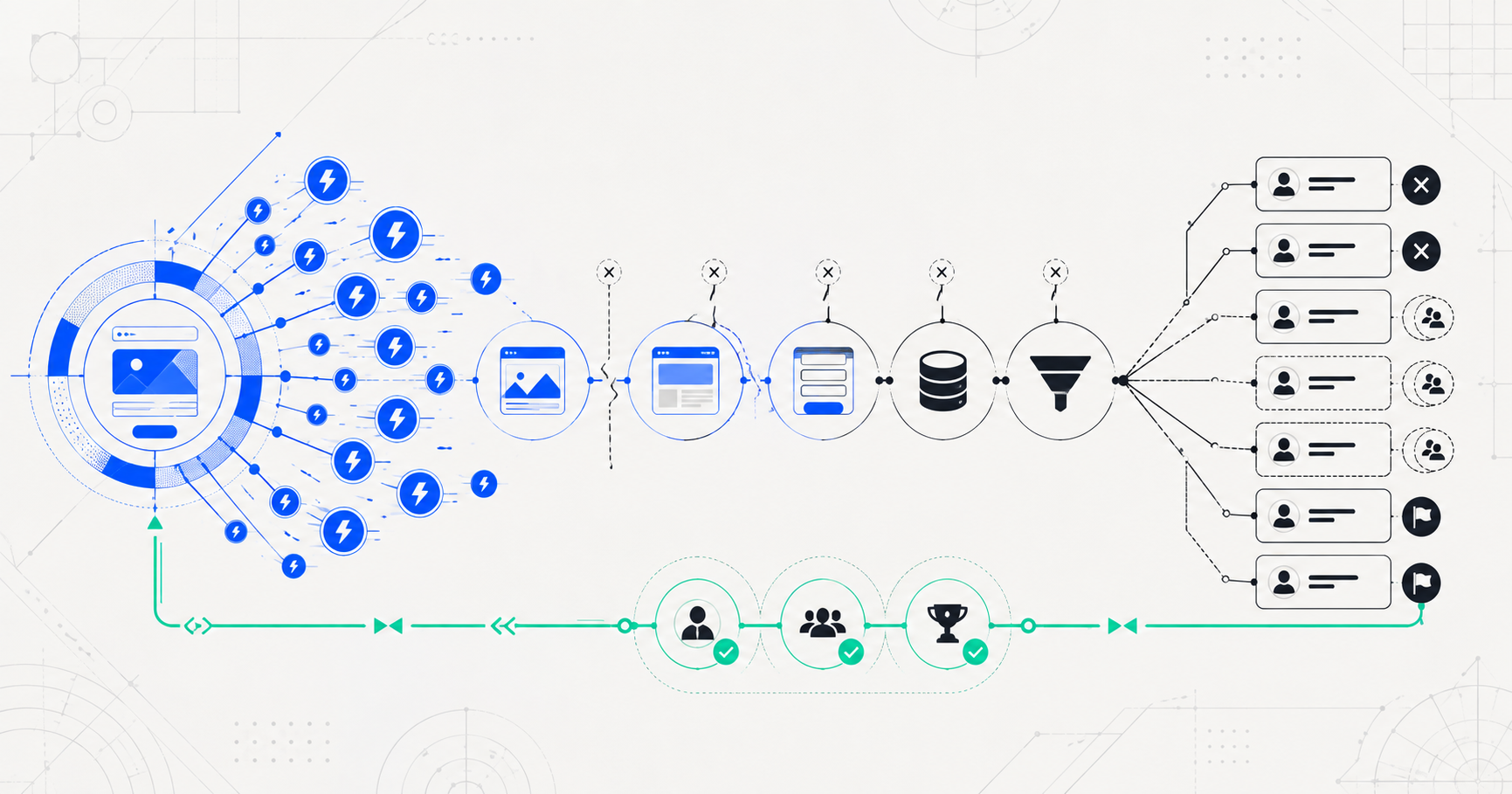
Google Ads can report more conversions while the sales team receives poor leads. Both reports can be accurate.
The advertising platform records the conversion actions configured in the account. If the primary goal is a form submission, the campaign can optimize toward people likely to submit that form. It does not automatically know which submission was spam, outside the service area, unqualified, unreachable, or eventually converted into revenue.
This is not a reason to abandon automated bidding. It is a reason to improve the business signal being sent back to the platform. Before changing keywords, budgets, or agencies, audit the measurement chain from ad click to closed outcome.
A platform conversion is only the event you defined
Begin with the account’s conversion goals. List every action included in bidding and document:
- Where the action fires.
- Whether it can fire more than once for the same outcome.
- Whether it represents intent or merely engagement.
- Whether the action is primary or observational.
- Whether its value reflects a defensible business difference.
- Which campaigns use it for optimization.
Common measurement problems include thank-you pages that reload, duplicate tags, imported and native events counting the same action, calls counted before meaningful engagement, test submissions, and low-value micro-actions included as primary goals.
A click on a phone number can be useful diagnostic data, but it is not the same as a completed call. A completed call is not necessarily a qualified inquiry. A form submission is not a signed customer. Preserve those distinctions.
Our paid media service treats tracking, landing pages, and downstream quality as part of campaign management rather than evaluating success from click and form totals alone.
Create a conversion ladder that matches the sales process
Define a small number of stages that sales can apply consistently. A practical lead-generation ladder may include:
- Submitted lead. A form, call, chat, or booking was received.
- Valid lead. The contact is real, unique, and reachable.
- Qualified lead. It fits the service, geography, need, and other agreed criteria.
- Converted lead. The opportunity reached the commercial outcome defined by the business.
Google Ads’ current guidance for enhanced conversions for leads recommends using qualified-lead or converted-lead goals for advertisers measuring offline outcomes. The exact stages still belong to the business. A platform label cannot resolve an inconsistent qualification process.
Write objective criteria for each stage. If one sales representative marks a lead qualified after a phone connection while another requires budget and timing confirmation, the imported data will be inconsistent. Automated systems can learn from the signal, but they cannot repair an unstable definition.
Do not assign arbitrary values merely to make value-based bidding available. If lead stages have different values, derive them from observed close rates, expected margin, or another documented commercial method and review them as economics change.
Return qualified outcomes to Google Ads with consent and identifiers intact
For businesses that close leads outside the website, the measurement path must preserve a way to associate later outcomes with the original ad interaction.
Google’s documentation describes enhanced conversions for leads as an upgraded offline-conversion process that can use hashed first-party data, such as email or phone, alongside click identifiers to improve measurement. It also emphasizes customer-data policies, consent, diagnostics, deduplication identifiers, and accurate conversion timestamps.
A robust implementation should:
- Capture the required click and source identifiers where appropriate.
- Store the original landing page and campaign context.
- Obtain and record consent according to applicable requirements.
- Normalize and protect first-party data using the supported implementation.
- Send qualified or converted outcomes with the correct event time.
- Use a stable transaction or order identifier when supported to reduce duplicates.
- Monitor diagnostics and rejected imports.
The implementation method can change as platform APIs and integrations evolve. Review current official documentation before development and test with non-production records where possible.
Do not upload customer data merely because the tool allows it. Confirm that collection, storage, processing, retention, and advertising use comply with the business’s legal obligations and Google’s policies.
Fix the landing page before blaming lead quality on targeting alone
The page determines who self-selects into the form. If the ad promises one service while the destination speaks broadly about the entire company, users may submit without understanding price, location, scope, eligibility, or next steps.
Google explains that landing-page experience is one of the three components shown in Quality Score, alongside expected CTR and ad relevance. Google also states that Quality Score is a diagnostic tool, not a KPI and not a direct auction input.
Use it to identify possible relevance problems, but evaluate the page through actual business outcomes. Confirm that it:
- Matches the keyword and ad promise.
- States who the offer is and is not for.
- Explains material conditions before submission.
- Provides relevant proof and a clear next step.
- Works on mobile and handles errors visibly.
- Sends complete, non-duplicated events.
Google’s guidance on optimizing ads and landing pages recommends matching the page to the ad, keyword, and call to action. A dedicated landing page design can help when a campaign needs one offer and one conversion path, but the page must still provide enough information for responsible self-qualification.
Do not hide essential exclusions simply to increase form volume. Lower volume with clearer fit can be commercially stronger than a larger count that consumes sales time without producing opportunities.
Make sales feedback structured enough to optimize
“The leads are bad” is a warning, not a diagnosis. Require a small, consistent reason set, such as:
- Spam or fraudulent.
- Duplicate or existing customer.
- Wrong service.
- Outside geography.
- Unreachable after defined attempts.
- Below qualification threshold.
- Qualified but not ready.
- Qualified opportunity.
- Won or lost with reason.
Avoid an unbounded notes field as the only feedback. Notes provide context, but structured reasons allow comparisons by campaign, search term, audience, landing page, device, location, and time.
Review lead quality with both teams. Marketing should see which queries and ads produced each outcome. Sales should see what the ad and page promised. This prevents two common failures: sales rejecting leads that match the published offer, and marketing defending conversions that never had commercial value.
The creative argument matters too. Our analysis of the performance creative gap explains why media, messaging, and business feedback need to shape one another rather than operating in separate departments.
Change the bidding signal only after the data is dependable
Once qualification is consistent and offline outcomes are returning reliably, review which actions should guide bidding. Keep early-stage actions available for observation when they help diagnose volume, but do not automatically give every action equal influence.
Allow for conversion delay. A recent campaign may show many submitted leads and few qualified outcomes simply because sales has not processed the cohort. Compare mature periods and retain the original event dates.
Then evaluate:
- Cost per submitted, valid, and qualified lead.
- Qualification rate by campaign and query group.
- Accepted-opportunity and close rate.
- Recorded value or margin where available.
- Time to first response and time to qualification.
- Import coverage and diagnostic errors.
Do not change the form, targeting, bidding strategy, campaign structure, and qualification rules simultaneously if the goal is to identify causality. Sequence changes and document them.
The Bottom Line
Google Ads does not know a lead is bad unless the measurement system defines quality and returns that outcome.
Audit primary conversion actions, remove duplicates and low-value goals from bidding where appropriate, create consistent lead stages, preserve attribution identifiers, and send qualified outcomes back through a policy-compliant implementation. Align keywords, ads, landing pages, and sales criteria so the same offer is being evaluated throughout the journey.
The goal is not to make the advertising dashboard look worse by replacing form volume with stricter outcomes. It is to give the business and the bidding system a more honest definition of success.